
You have probably heard something about Google changing. Maybe a client mentioned their traffic has dropped. Maybe you have noticed that the search results look different when you Google something yourself. Maybe someone told you SEO was dead.
It is not dead. But it has changed significantly, and the businesses that understand the change now are the ones that will be in front of the right customers in 12 months. This briefing explains what has happened, what the new search experience looks like, and what it means for how you get found online.
What Has Google Actually Changed?
At its annual developer conference in May 2026, Google announced what it called the biggest upgrade to its search experience in 25 years. The headline feature is something called AI Mode, powered by Google’s Gemini AI, which now sits at the heart of how search results are presented.
For most of the internet’s existence, a Google search returned a list of ten blue links. You clicked one, read the page, came back, clicked another. That model is now being replaced by something fundamentally different.
Google’s VP of Search described the change as: the biggest upgrade to our iconic search box since its debut over 25 years ago.
The new search experience works more like a knowledgeable assistant than a filing cabinet. Instead of handing you a list of websites, Google reads the relevant content across the web, synthesises an answer, names the brands and sources it drew from, and presents it to you directly. The links still exist, but they now sit below the AI-generated summary rather than leading the page.
This is not a small cosmetic tweak. It is a structural change to how visibility works online, and it affects every business that relies on search to bring in customers.
What Does the New Search Page Look Like?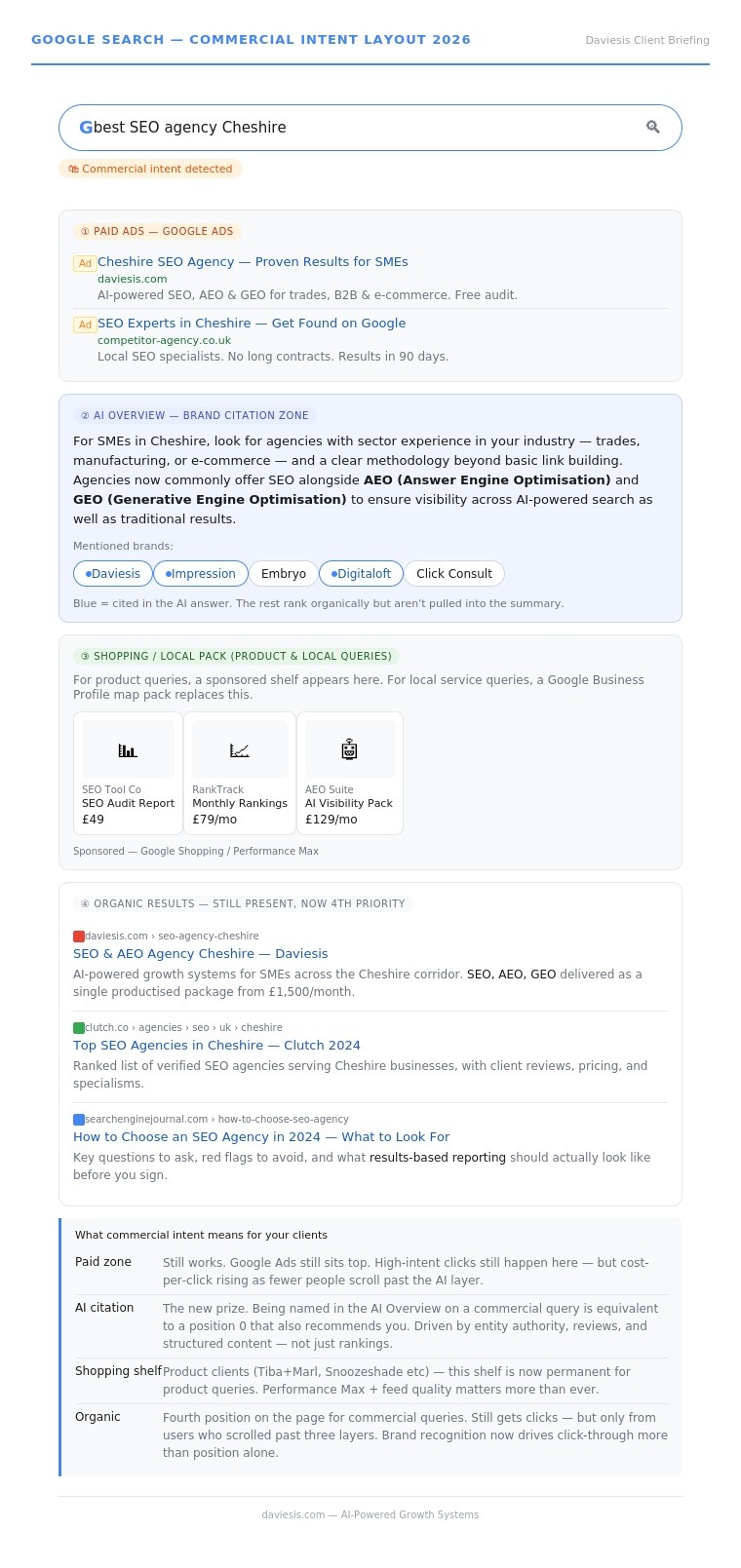
If you run a search with any kind of commercial intent today, whether you are looking for a product, a service, or a local business, the page you see is structured in four distinct layers.
Layer one: paid advertising
Google Ads still sits at the very top of the page. If you are running paid search campaigns, your ads appear here as they always have. This layer has not changed in its placement, though the cost of appearing here is rising as the organic landscape shifts.
Layer two: the AI Overview
This is the new and most significant layer. Before any organic results appear, Google presents a synthesised summary of the topic you searched for. It is written in natural language, draws from multiple sources across the web, and critically, it names specific brands and businesses within the answer.
Being named in the AI Overview is now one of the most valuable forms of visibility in search. When someone searches for the best garden room company in Cheshire, or the best accountant for small businesses in Manchester, and Google names you in its answer, that recommendation carries enormous weight. The user has been told to consider you before they have even seen your website listing.
Layer three: the shopping shelf or local pack
For product-based searches, a sponsored shelf of product listings appears here. For local service searches, a Google Business Profile map pack appears instead. Both of these sit below the AI Overview but above the traditional organic results.
Layer four: organic web results
The traditional blue link results still exist, but they now appear fourth on the page for most commercial searches. They still receive clicks, particularly from users who want to research further or who scroll past the layers above. However, the click volume reaching these results has fallen significantly as the AI layer captures more attention.
What Does This Mean for Traffic and Visibility?
There is an honest conversation to be had here. Direct clicks from search to individual websites have reduced for many query types. Research from late 2025 and early 2026 showed click-through reductions of between 30 and 46 percent when AI summaries appear above organic results. For some specific query types, particularly informational searches, the impact is even greater.
That is the uncomfortable truth. But it is only half the picture.
The businesses that are being named inside the AI Overview are not losing visibility. They are gaining a form of it that is qualitatively better than a position-one ranking ever was.
Consider what the AI recommendation represents. A potential customer searches for a product or service. Google reads thousands of web pages and then, on the customer’s behalf, decides which brands are worth considering and names them directly in the answer. That is not just visibility. That is an endorsement from the most trusted information source most people use every day.
The question for every business is not whether this is happening. It is whether you are one of the brands being named, or one of the brands being passed over.
What Makes Google Cite a Brand in Its AI Answer?
This is the question that matters most practically. The AI Overview is not pulling brands at random, and it is not simply ranking the websites that appear first in traditional search results. Research tracking AI citations found that in mid-2025, roughly 76 percent of brands cited in AI answers came from pages that also ranked in the top ten organic results. By early 2026, that figure had dropped to around 38 percent. You can rank well on Google and still be completely invisible inside the AI layer.
So what does drive citation? There are several factors, and they work together rather than independently.
Entity clarity
Google needs to understand clearly what your business is, who it serves, where it operates, and what it is known for. This goes beyond having a website. It means your business information is consistent across every place it appears online, your Google Business Profile is complete and accurate, and your website uses structured data markup that helps Google categorise what you offer. Businesses with ambiguous or inconsistent online footprints are difficult for the AI to confidently recommend.
Third-party authority signals
The AI draws from sources it considers reliable. Reviews on Google and industry platforms, mentions in trade publications and local press, listings in reputable directories, and citations from other trusted websites all contribute to the authority that makes a business citation-worthy. This is why businesses that have invested in building a genuine reputation online tend to appear in AI answers more frequently than those relying solely on their own website content.
Content that answers the questions buyers ask
The AI Overview is built from content that answers search queries directly. If someone searches for the best conservatory company in the North West and asks about planning permission, costs, timelines, and what to look for, the businesses whose websites answer those questions clearly and in depth are far more likely to be drawn into the summary. Thin, generic website content does not get cited. Content that genuinely addresses buyer questions does.
Sector and location specificity
The AI is good at matching businesses to queries where there is a clear fit between what the business offers and what the searcher needs. Being clearly positioned within your sector and geography, rather than presenting as a generalist, improves the likelihood of being cited for the queries that matter to your customers.
The Channels That Matter Most Right Now
Given what has changed, the most effective approach for businesses combines several things that work together within the new landscape.
SEO: the foundation that does not go away
Traditional search engine optimisation is still relevant and still necessary. Ranking well in organic results remains valuable, particularly for query types where the AI Overview is less prominent, and organic presence contributes to the authority signals that drive AI citation. The work of making your website technically sound, well-structured, and rich in relevant content remains the foundation of everything else.
AEO: optimising for the AI answer
Answer Engine Optimisation is the newer discipline built specifically around the AI Overview. It focuses on structuring content so that Google can extract clear, citable answers from it. This involves FAQ content built around real buyer questions, concise and accurate business information, schema markup that signals what your pages are about, and content that addresses the full journey a buyer goes through, not just the final purchase decision.
GEO: being visible across AI platforms
Generative Engine Optimisation extends this further. Google is not the only AI that people are now using to research purchases and find businesses. ChatGPT, Microsoft Copilot, Perplexity, and others all pull from the web to generate answers. The signals that earn citation in one AI platform are broadly transferable to others. Building visibility across the AI search landscape rather than focusing solely on Google is increasingly important as user behaviour shifts.
Google Business Profile and local visibility
For businesses serving a local or regional area, the Google Business Profile has never been more important. It feeds the local pack that sits in the third layer of commercial search results, and it contributes to the entity data that influences AI citations for local queries. Keeping it accurate, actively gathering reviews, and posting regularly are all high-value activities given how prominently it now features.
A Word on Information Agents
One of the more significant features announced at Google I/O 2026 is something called Information Agents. These are persistent, background processes that monitor the web on behalf of a user and push alerts when something relevant happens.
A customer sets up an agent to track, say, garden room companies in their area. Every time a new review appears, a new article is published, or pricing changes, the agent flags it. This is Google moving from a reactive tool you use when you have a question, to a proactive assistant that stays engaged with topics you care about over time.
For businesses, this means your ongoing online presence, not just your website at a single point in time, becomes part of how customers discover and evaluate you. Businesses that publish consistently, gather reviews regularly, and maintain an active and accurate online footprint will be surfaced more readily by these agents than those with static or irregular presence.
Frequently Asked Questions
Has Google killed SEO?
No. SEO remains relevant and necessary. What has changed is that organic rankings are no longer the primary measure of visibility. The AI Overview, the local pack, and the shopping shelf all sit above traditional organic results for commercial queries. SEO is now one part of a broader visibility strategy rather than the whole of it.
Do I still need to invest in my website?
Yes, more than ever. Your website is the source that both Google’s AI and users return to once a citation or result has caught their attention. A website that is slow, unclear, or thin on useful content will not convert the visibility that good SEO and AEO work generates. The website and the visibility strategy need to work together.
My traffic has dropped. Is that because of these changes?
It may be a contributing factor, particularly if the drop coincides with the wider rollout of AI Overviews in 2024 and 2025. However, traffic volume and business impact from search are not the same thing. If the traffic that remains is more intent-driven and better qualified, that may be more valuable than the volume you had previously. This is worth analysing properly rather than assuming the worst.
What should I prioritise first?
Start with entity clarity. Make sure your Google Business Profile is complete and accurate, that your business information is consistent everywhere it appears online, and that your website clearly communicates who you are, what you offer, who you serve, and where you operate. From there, the content and schema work of AEO builds on that foundation.
Is this going to keep changing?
Yes. The AI layer in search is developing rapidly and Google is rolling out new features on a quarterly basis. The principle that guides a sustainable approach is to build genuine authority and clarity around your business online rather than chasing individual tactical changes. Businesses with strong foundations adapt more easily to each new development than those relying on narrow optimisations.
Does this affect my Google Ads?
Paid ads still sit at the top of the page and still drive clicks, particularly for high-intent queries. However, the cost per click for competitive terms is rising as the organic landscape shifts and more advertisers compete for the remaining premium positions. Paid search continues to have a place in the mix, but it works best when combined with strong organic and AI visibility rather than in isolation.
The Opportunity Is Real
It would be easy to read all of this as bad news. It is not. The businesses investing in visibility across SEO, AEO, and GEO right now are positioning themselves for a landscape where the channel is not shrinking but deepening. Google is processing more queries, handling more complex questions, and being used for more stages of the buying journey than ever before. The opportunity to reach the right customer at the right moment has grown, not contracted.
What has changed is the game. The businesses that learn the new rules quickly are the ones that will benefit most from a search channel that is, by Google’s own description, being rebuilt from the ground up.